Recent Articles
September 1, 2026
ABS extends condolences to the families and friends of this ABS member who recently passed away:
September 1, 2026
This is a follow-up to an earlier article promoting the importance of securing items in your cargo section before each flight. For those who missed the news, beloved instructor, mentor, and good friend to many, Ron Timmermans and his wife Barbara perished in a plane crash that may have been survivable if not for the items flying forward from the cargo area. The investigation is ongoing, so all such is preliminary speculation, but it was apparently so notable that the NTSB took the extraordinary step of contacting Tom Turner to remind all pilots to take this precaution.
September 1, 2026
Since I received my newer B36TC back from exterior paint and interior redo, my landing gear warning horn does not go off when the throttle is pulled back to idle. This was confirmed on jack stands and tested in the idle position.
September 1, 2026
I’m liking my A&P more and more every day, even though the things he finds cost me money. He found this on my P35 today: The right main retract rod is rubbing against the support/idler for the door rod. It looks as if there should be some spacer between the spider and the gear rod end that holds it up. His initial thought was that the washer was installed on the top of the rod instead of between the rod and the spider, but he had just found it when I showed up and hadn’t gotten into the books yet. I don’t see anything in either the Illustrated Parts Catalog or the ABS Landing Gear manual. Obviously, I’m going to have him look at the other side as well. The rubs on the actuator rod look somewhat minor, so I think this has not been a long-term problem, and most likely in conjunction with the combined pre-buy/annual I had done last October elsewhere.
September 1, 2026
My aviation journey began when I soloed a Cherokee 180 on July 27, 1973, 53 years ago—that doesn’t seem possible!
September 1, 2026
U.S.-based Arcline Investment Management is buying Continental Aerospace Technologies from the Aviation Industry Corporation of China (AVIC) for $535 million. The deal was announced June 8. Arcline has $30 billion in assets, and among its holdings is Signia Aerospace, which owns Hartzell Aviation, Hartzell Propeller, Cleveland Wheel & Brake Systems, and a half-dozen other aviation concerns.
September 1, 2026
My new-to-me P35 needs a gear warning horn adjustment; it comes on at 20” manifold pressure. My A&P says it should be 18” manifold pressure based on the maintenance manual. I thought it would be lower. What is correct and where can it be found?
September 1, 2026
After decades of flying my Bonanza behind a trusty Continental IO-550, I’ve come to appreciate something many Bonanza owners know well: The airplane itself may be timeless, but the technology under the cowling sometimes feels like it’s stuck in another era.
September 1, 2026
My first flight was on October 25, 1965, in an 85 hp Cessna 140 (N725X) as a new student member of the SJSU flying club known as the “Flying 20” (established 1947), piloted by San Jose State University Aviation Professor and CFI, Jerry Shreve.
September 1, 2026
I’m currently working on a 1993 F33A that is having issues with the landing gear retraction. When the landing gear is swung while up on jack stands, the up-limit switch is maxing out and actually being bent slightly from the screw on the transmission. The up-limit switch tests are good, and it has been changed just to be sure. I have tried changing the dynamic brake relay (DBR) as well as polishing all the contacts on it thinking that it was the reason for the coast. I can hear the DBR actuate in both directions with the motor disconnected, and it seems to be functioning as intended. I removed the motor and held it in my hand while checking the up and down limit switches and it stops immediately in both directions while connected to the DBR. I have tried three different grounds for the DBR and even tried putting the motor straight to ground (all were tested with a Fluke 179 and were good grounds). The only weird thing I have noticed is when I had the motor in my hand, it sounded like it was spinning faster when I was going toward gear up than gear down. So,…
September 1, 2026
We occasionally get calls from ABS members about the application that the insurance companies require to be completed when you buy or renew an aircraft policy. Here are some of those questions and our typical responses that might help you when completing this document.
September 1, 2026
I just recently completed the American Bonanza Society’s Landing Gear Inspection Guide checklist on my V35 Bonanza with my mechanic. This guide was great and really helped me to understand how my landing gear system works. I do have several questions, however.
September 1, 2026
As of July 31, 2026, there have been 65 reported accidents involving Beech Bonanzas, Debonairs, Barons, and Travel Airs this year. All information is preliminary and subject to revision as the final, official investigations conclude. Please review the trends suggested by these reports and develop a training and practice plan to help you avoid repeating accident history.
September 1, 2026
There are two things likely to surprise you about engine failure:
September 1, 2026
Is there a procedure to eliminate the shuttle valve in the B55 dual brake system? I recall seeing that someone had removed the shuttle valves from the system—is this possible? If I use my copilot-side brakes, both brakes will drag (sometimes almost locked). I have found that the only way to undo this (besides bleeding pressure at the calipers) is to stand on the copilot brakes with all the force I can muster and then actuate the pilot side brakes. I’m assuming the shuttle valve is sticking in a middle position where it can trap fluid in the lower lines. Is this possible?
Distinguishing Features
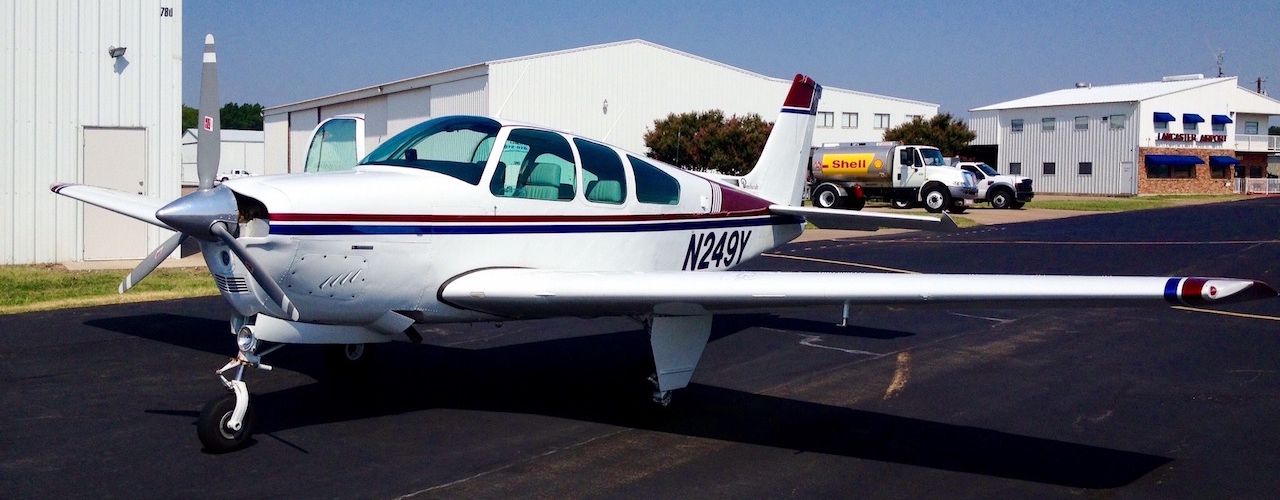
- Conventional (“straight”) tail
- “Speed sweep” windscreen (no center post)
- Large third window
- Vertical stabilizer dorsal fin
- Optional long range fuel tanks (80 gal. total)
- Single, throw-over control yoke
- Vernier engine and mixture controls
- Electric auxiliary fuel pump
- Gear handle on right, flap on left
- Cowl flaps
- Landing light on nose cowling
Common options and modifications
- Engine upgrades
- Tip tanks
- Improved cabin ventilation system
- Instrument panel and/or avionics upgrades
- Interior upgrades
- Dual control yoke
SERIAL NUMBER EXCEPTIONS
The following E33As carried CE-series serial numbers but were E33C Aerobatic Bonanzas, and are correctly identified using CJ-series serial numbers listed in parentheses. See the Bonanza E33C page for more information.
|
CE-236 (CJ-1)
|
CE-243 (CJ-8)
|
CE-252 (CJ-15)
|
CE-261 (CJ-22)
|
|
CE-237 (CJ-2)
|
CE-244 (CJ-9)
|
CE-253 (CJ-16)
|
CE-262 (CJ-23)
|
|
CE-236 (CJ-3)
|
CE-245 (CJ-10)
|
CE-254 (CJ-17)
|
CE-263 (CJ-24)
|
|
CE-239 (CJ-4)
|
CE-246 (CJ-11)
|
CE-255 (CJ-18)
|
CE-269 (CJ-25)
|
|
CE-240 (CJ-5)
|
CE-247 (CJ-12)
|
CE-257 (CJ-19)
|
|
|
CE-241 (CJ-6)
|
CE-248 (CJ-13)
|
CE-258 (CJ-20)
|
|
|
CE-242 (CJ-7)
|
CE-251 (CJ-14)
|
CE-259 (CJ-21)
|
|
|
The following serial number E33As were removed from civilian production and converted to U.S. Air Force Pave Eagle I aircraft:
CE-218 CE-219 CE-221 CE-222 CE-223 CE-224